Velodrome token swaps and liquidity rewards
Last updated ·
Velodrome is a decentralized exchange using rewards and pool voting to attract swap liquidity on Optimism and the Superchain. Its automated market makers price trades using deposited tokens. Liquidity providers can earn fees or stake eligible positions for VELO emissions, while locked VELO supplies voting power over reward allocation.
In short: Staking an eligible liquidity position exchanges its future trading fee entitlement for emissions, so reward comparisons must account for the staking state.
Liquidity, emissions and trading demand
When a pool attracts liquidity, its available token reserves support swaps, while votes help determine the emissions its gauge receives. A gauge is the contract distributing liquidity rewards. Traders pay swap fees, liquidity providers supply the assets and holders of veVELO voting locks direct rewards toward selected pools. Buying the liquid VELO token alone creates neither a liquidity position nor voting rights.
Emissions are newly issued VELO allocated to eligible staked liquidity. They differ from trading fees generated by swaps. External voting incentives can attract votes as a token market develops. More votes can increase an allocation, although liquidity demand and token prices can change. Reward spending therefore does not establish a permanent level of pool depth or trading activity.
Token identities and spending permissions
Using a pool requires the correct token contracts on its network, plus the permissions its router or position manager needs.
Tokens and networks
A token symbol does not uniquely identify a contract. Network and contract address distinguish the actual asset used by a pool. Basic liquidity deposits produce ERC-20 liquidity provider (LP) tokens representing a pool share. Slipstream deposits use position NFTs, or non-fungible tokens, under the ERC-721 standard.
Approvals and wallet authorization
An ERC-20 allowance authorizes a specified spender to move tokens up to the approved amount. Deposits and swaps use the appropriate router or position manager; staking uses the corresponding gauge. Approval scope matters because an authorized contract can exercise its permission without another approval for each transfer. A wallet connection itself transfers no assets. The transaction destination and requested permission reveal what a subsequent authorization allows. A compromised interface can request harmful permissions even when the pool contracts remain intact.
Stable and volatile pool curves
Velodrome V2 uses a stable curve for closely correlated tokens and a volatile curve for assets whose relative prices vary.
Stable pools
Stable pools suit assets expected to remain closely correlated. Their curve uses x³y + xy³, where x and y are normalized token reserves. It supports relatively small price changes near balanced reserves. The curve does not enforce a token’s peg. A loss of correlation can change the pool’s composition and the value of its liquidity positions.
Volatile pools
Volatile pools use the constant-product relationship x × y. Here, x and y represent token reserves; swaps change their relative amounts and the available exchange rate. Larger trades relative to reserves move the price further. Deposits into existing basic pools follow the reserve ratio, and LP tokens represent proportional ownership rather than a chosen price interval.
Slipstream liquidity inside a price range
With Slipstream, liquidity providers choose a price interval, concentrating their assets where trades can use them while the market remains inside it.
Ticks identify discrete price boundaries, and tick spacing determines which boundaries a pool permits. The position manager records each deposit’s range and liquidity in an NFT. A narrower interval concentrates liquidity more tightly. It also leaves less room for the market price to move before the position becomes inactive.
Slipstream gauge emissions accrue only to staked liquidity active at the pool’s current price. An out-of-range position remains a position, with underlying assets following the concentrated liquidity curve. Crossing a boundary does not itself destroy the NFT or withdraw its assets.
Unstaked positions earn their applicable swap fees. Staking redirects subsequent fees associated with that liquidity toward voter rewards and substitutes emissions. Slipstream can also charge a configured share of unstaked fee earnings.
Fees, price impact and gas
For a quoted trade, the amount supplied, available liquidity and each pool’s fee determine the estimated output before any network transaction charge.
Price impact is the change a trade causes along the pool’s pricing curve. Slippage describes a difference between the quoted and executed outcome. A minimum-output condition limits the acceptable deterioration for an exact-input swap. Within a single-chain transaction, a failed required swap reverts its state changes, although execution can still consume network fees.
Pool fees can vary by configuration and module. A concentrated pool’s tick spacing does not permanently determine its swap fee. Routes crossing several pools encounter the fees and liquidity of those pools.
Network fees pay for execution and depend on the chain, transaction work and prevailing fee conditions. Separate approval transactions can add execution costs when an existing allowance is insufficient. Liquidity provision also changes exposure to the deposited assets. Impermanent loss describes a position worth less than holding the same starting assets separately after their relative prices change. Fees and emissions contribute to returns without guaranteeing they offset that difference.
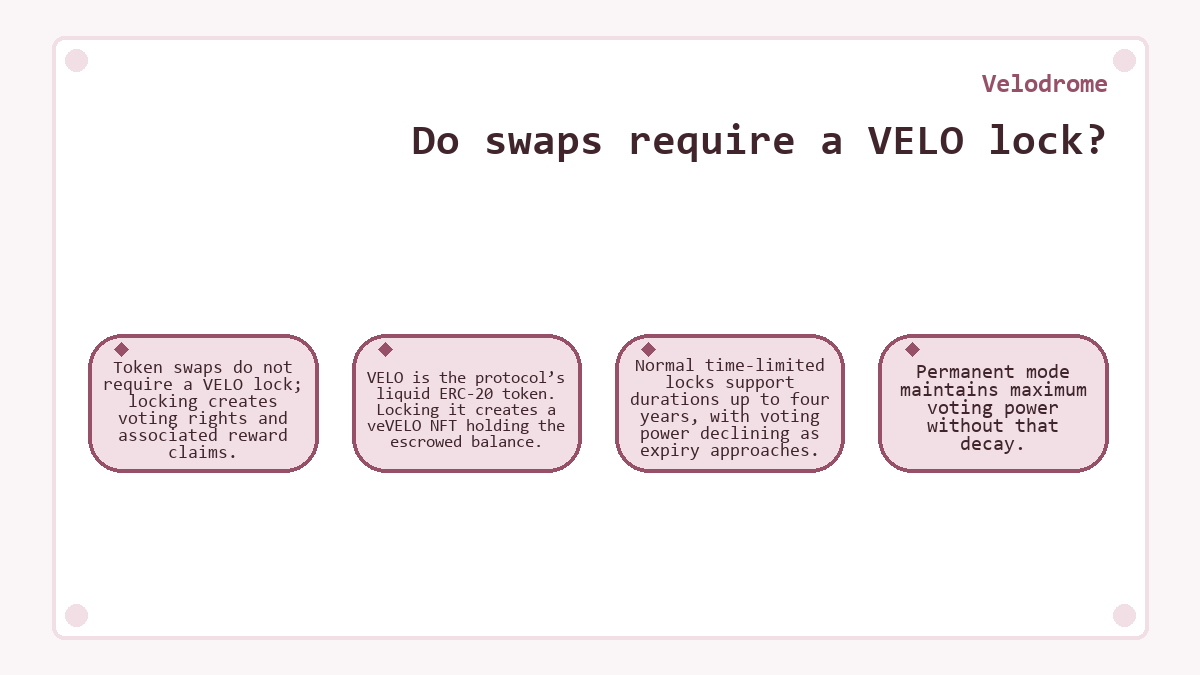
Do swaps require a VELO lock?
Token swaps do not require a VELO lock; locking creates voting rights and associated reward claims. VELO is the protocol’s liquid ERC-20 token. Locking it creates a veVELO NFT holding the escrowed balance. Normal time-limited locks support durations up to four years, with voting power declining as expiry approaches. Permanent mode maintains maximum voting power without that decay.
Gauges, voting rewards and managed locks
Liquidity rewards
When liquidity qualifies for emissions, its gauge distributes the allocated rewards according to the stake and the applicable pool accounting. Velodrome V2 organizes allocations into weekly epochs. Basic pool gauges account for each account’s staked LP balance over time. Staking basic pool LP tokens redirects their trading fee entitlement to the pool’s voting reward contract. Slipstream gauge implementations with a configured penalty can deduct emissions claimed before their minimum staking time. Withdrawal also settles rewards under that penalty rule. The deduction affects emissions, not the position’s deposited liquidity. An early reward claim can incur the penalty even when the position remains staked.
Voting fees, incentives and rebases
Pool voters receive fee rewards and eligible external incentives in proportion to their allocated voting weight. These payments follow epoch accounting and can contain different tokens. Rebases are a separate distribution associated with locked VELO. Claims add VELO to eligible active timed locks and permanent locks; expired timed locks receive unlocked VELO. These distributions are separate from swap-fee rewards.
Managed locks and Relay
Managed veNFTs aggregate deposited voting power. Relay provides automation around these positions, including reward conversion and compounding. Its autocompounder converts rewards into VELO and adds them to the managed lock. The autoconverter design converts rewards into a designated token without compounding the lock. Authorized operators control voting. Autocompounder administrators can send reward tokens absent from the high-liquidity list to chosen recipients during the first day of an epoch. The autoconverter design allows administrators to transfer any reward token without that epoch restriction. Withdrawal from a managed lock is blocked during the epoch of deposit. It restores a veNFT with the maximum timed-lock duration, keeping the underlying VELO escrowed.
Superswaps between connected networks
Where compatible assets and deployed routers support the route, Superswaps combines cross-chain value transfer with swaps using liquidity on connected networks. The architecture extends the Universal Router with bridging and destination-execution commands. Hyperlane supplies a supported messaging path, and Open USDT can serve as an intermediary asset. The router also supports other compatible cross-chain tokens. Available routes depend on deployed contracts, messaging support and liquidity at the required endpoints.
Confirmation of the originating transaction does not establish receipt of the requested destination token. Destination processing and the recipient’s resulting token balance distinguish a completed swap from an outstanding message or a fallback transfer. The selected route also determines which interoperability costs apply.
Velo Launch and locked pool deposits
For creating a token’s liquidity market, Velo Launch supports pool setup, initial pricing and deposit locking through a dedicated launch interface. A launched liquidity deposit remains distinct from a veVELO voting lock. Locking the deposit restricts withdrawals and, for a ranged position, changes to its price interval. The owner can add liquidity, and eligible locked deposits can still be staked or unstaked. Unlocking becomes available when the deposit’s expiration condition is satisfied.
Locked launch deposits can use a share of accrued fees or rewards as incentives for their own pool. An emerging pool can become eligible for staking rewards without migrating its underlying deposits. That eligibility change does not remove the deposit lock. Other products using the launcher infrastructure can assign a beneficiary share of rewards, so a launch-related distribution can differ from the owner’s gross earnings.
Position ownership and exit conditions
When assets enter a pool or escrow, the holder controls a contract-backed position whose withdrawal rules differ from an ordinary wallet balance.
| Participation option | Asset custody and withdrawal control |
|---|---|
| Unstaked basic pool liquidity | The pool holds deposited assets; the LP token holder controls redemption of the pool share. |
| Staked basic pool liquidity | The gauge holds LP tokens; the account credited with the stake controls unstaking before redeeming the returned pool share. |
| Unstaked Slipstream liquidity | Pool contracts hold assets; the position NFT owner controls liquidity changes through the position manager. |
| Staked Slipstream liquidity | The gauge holds the position NFT; the depositor controls withdrawal under that gauge’s rules. |
| Time-limited veVELO lock | The escrow holds VELO; withdrawal from a normal lock requires expiry. |
| Permanent veVELO lock | The owner controls the NFT; VELO remains escrowed while permanent mode stays active. |
Unstaking returns the position representation. Removing liquidity redeems its underlying assets. Turning off permanent mode requires a normal veNFT with no recorded pool votes and starts the maximum timed-lock duration. Votes cast in the current epoch cannot be reset until a later epoch. VELO remains escrowed until the new expiry.
Protocol controls and the Aero transition
Velodrome V2 combines immutable deployed contracts with factory registries and configuration roles for supported pool types and fee settings. The emergency council can deactivate or revive gauges. A deactivated gauge loses access to new emissions, which affects future rewards rather than rewriting token ownership. Factory revisions can change position-management requirements, so a pool name alone does not identify its contract generation. Spearbit reviewed V2 and Slipstream contracts, while ChainSecurity and Sherlock reviewed the Superchain release.
The full Aero launch announced on 25 September 2026 is scheduled for 22 October 2026 at 00:00 UTC. The merger will combine Velodrome and Aerodrome in a new protocol using AERO tokens and sAERO staking positions. Aero Lite on Arc is already a separate limited deployment. The full transition changes allocation and reward mechanics, so existing weekly veVELO rules do not describe every Aero feature. VELO and veVELO holders will need to upgrade their tokens and positions. veNFT positions deposited in other contracts must be withdrawn and pending rewards claimed before migration. Legacy contracts will remain onchain, while gauges and factories are planned for retirement. Further guidance for liquidity providers is planned before launch.
What readers ask about Velodrome
Can tokens with transfer fees use a Velodrome zap?
The Velodrome V2 router’s zap functions support standard ERC-20 tokens and exclude fee-on-transfer tokens. A zap converts a supplied asset into the tokens needed for a liquidity position, or converts a redeemed position into an output asset. Its separate swap and liquidity functions include variants supporting fee-on-transfer tokens.
Is a pool’s displayed APR a compounded return?
APR (annual percentage rate) expresses an annualized reward rate without assuming compounding. Pool estimates use the relevant fee or emission amounts and their liquidity denominator. A concentrated position’s changing range status can make its realized rewards differ from the pool estimate. Automated compounding through a supported strategy is a separate operation with its own mechanics and costs.
Does disconnecting a wallet revoke its token approvals?
Disconnecting a wallet leaves existing onchain token allowances unchanged. An allowance records a token owner’s authorization for a specific spender, independently of the website connection. Reducing or revoking it requires an onchain allowance update through an appropriate wallet or contract interaction. That change limits future authorized spending; it does not reverse transfers a contract has already executed.
Which asset arrives when a Superswap uses a fallback transfer?
A configured fallback transfer delivers the bridged asset on the destination chain instead of the requested swap output. Its availability depends on the destination command plan allowing the fallback to execute. This differs from a refund on the originating network. The received token and network establish what the recipient holds, regardless of the original output quote.
Can a Slipstream pool trade before it has an emissions gauge?
A Slipstream pool can support swaps without an emissions gauge because pool creation and gauge creation are separate. Unstaked liquidity can earn applicable trading fees, subject to the pool’s fee configuration. Emissions require an eligible funded gauge and a qualifying stake. A pool’s trading availability does not establish its emissions eligibility.